
Identify Who Owns a Hart County Property
Two Hart County offices split the work. The Board of Tax Assessors keeps the QPUBLIC card, which supplies the working owner name. The Clerk of Superior Court, through GSCCCA, keeps the recorded instrument that transferred an interest. Follow the route in that order. That way, a stale tax-roll entry never becomes the final answer on who owns a property.
- Enter the known situs address in Hart County QPUBLIC, or use a parcel or owner route that the live portal makes available.
- Read the card's Owner field, Parcel ID, physical address, mailing address, and data or upload date as separate facts.
- Search the owner as a grantee in the GSCCCA real-estate name index and locate the newest relevant deed.
- If the deed is newer than the parcel-card upload, ask the assessor when its owner record will reflect that transfer.
Here is the short answer. A QPUBLIC match identifies a candidate for owner of record. The newest relevant deed confirms the recorded event, and the Hart County current owner guide walks through the present roll fields in more detail.
Read Hart County Owner Fields as Separate Clues
An official 2025 Hart County Board packet shows what the Schneider parcel card can contain. Fields include Owner, mailing address, Physical Address, Parcel ID, class, district, acres, assessed value, sales, and a map. The card lists each one separately. The owner line is the main lead. It does not prove the mailing address is the property in question. Nor does the named party necessarily occupy the site.
Owner of record is the party carried on the assessment roll. Situs marks the physical property location. Mailing address tells you where assessment mail goes, and a grantee is the party receiving an interest in a recorded deed.
The county sample draws the line vividly. Its mailing and physical address lines differ, and the physical line ends in zero. When an address search fails, other clues can restore the trail. Road name, map number, owner name, and neighboring parcel IDs all work. Open the Hart County QPUBLIC entry page first. That official entry point is where the owner route begins.
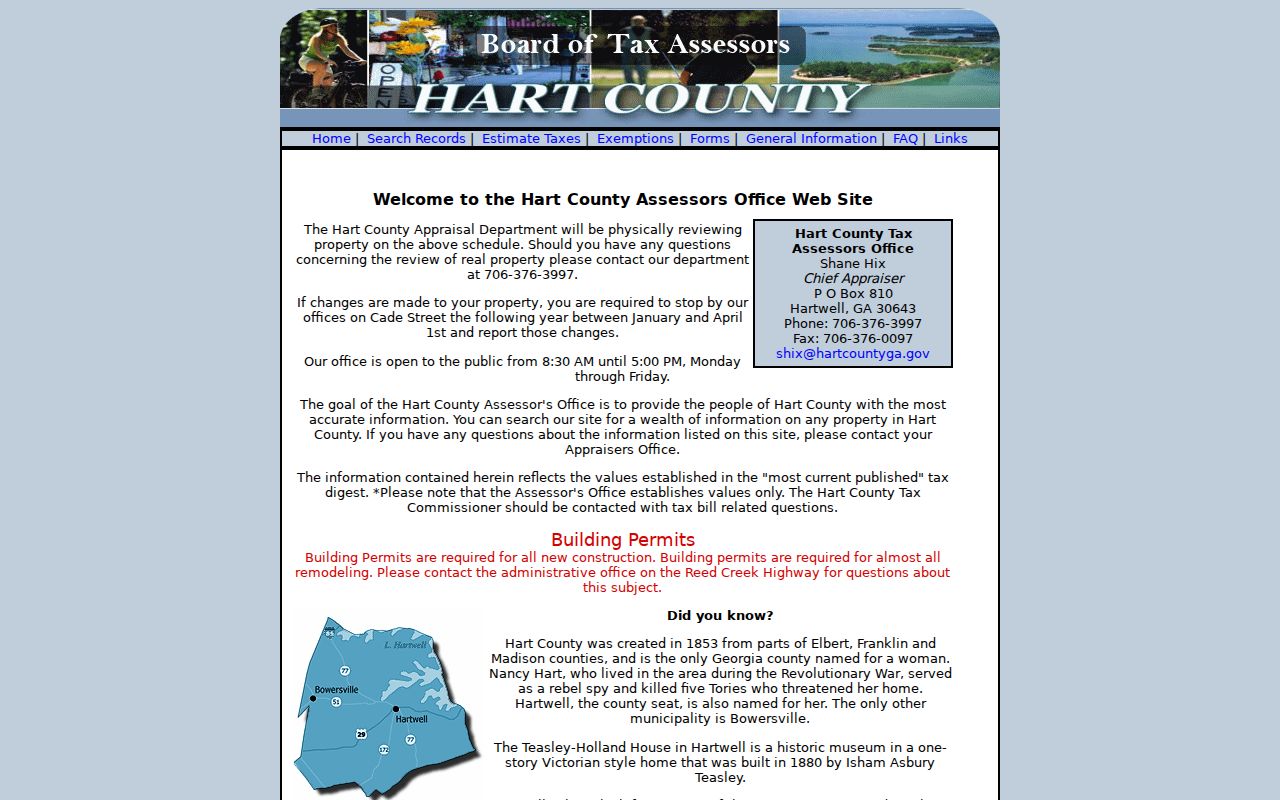
The QPUBLIC entry page confirms the official county search destination. The record itself must supply the owner and parcel details. Note: The sample parcel card states it is not for legal documents, so treat its owner line as a research lead.
Trace the Hart County Owner Name to a Deed
The Hart County Clerk of Superior Court records deeds, plats, liens, and related instruments. The office also handles security deeds and UCC filings. The county page directs researchers to Kofile and GSCCCA. It also notes that public real-estate records may be viewed in person. When the Kofile route stalls, GSCCCA and the courthouse counter are the firm fallbacks. On GSCCCA, keep party role and instrument type in view. A person in the index may be a grantor, grantee, lender, trustee, attorney-in-fact, or lien claimant. Never rely on name alone. Match the parcel through a legal description or subdivision. A book/page citation, map reference, or other deed details work too. That is what ties an indexed name to a specific piece of land.
Ownership check: an assessment-roll name is not a title search. A trust, estate, company, unrecorded event, or recent deed may change the legal picture.
Compare Hart County Property Owner Sources
No single database answers every ownership question. Each source holds the fact it was designed to keep, whether that is the tax roll, the plat map, or a recorded deed transfer. Comparing what each office maintains shows where the gaps fall.
| Where ownership appears | What it gives | How current |
|---|---|---|
| Hart QPUBLIC assessment roll | Owner, mailing and situs fields tied to a parcel | Current to its posted data upload, with no published closing-to-roll lag |
| Clerk or GSCCCA deed index | Indexed grantor, grantee, instrument, recording date, and citation | A newly indexed deed can precede the roll update |
| QPUBLIC parcel map | Mapped parcel outline, identifier, roads, and linked attributes | Reference layer, not proof of title or a survey |
| Georgia SOS business search | Entity name, status, officers, and registered agent routes | Useful for identifying an entity, not proving its land title |
For documents not available online, the Clerk's office at 185 W Franklin Street in the Courthouse Annex offers public viewing during office hours. The assessor can address roll timing at (706) 376-3997. A written request for a missing public record goes to the office that keeps it under the Georgia Open Records Act. That statute is the formal path when online deed records fall short.
Identify Hart County Owners Held in Trust or Company Names
A QPUBLIC owner can be an LLC, trust, or estate rather than an individual. Preserve the full spelling and every suffix. For an LLC, the Georgia Secretary of State business-search route identifies the organization record. Then you return to the deed index. For a trust, search the trustee or entity wording found on the deed. For an estate, try the decedent, the estate name, the executor, the administrator, and any representative's deed. These searches identify parties connected with a record. They do not authorize an inference about who lives at the property. Probate orders may explain a transfer that is not obvious from an ordinary deed sequence. Hart County Probate Court is the local source when an estate proceeding matters.
Use Hart County Deed Alerts After You Identify the Owner
The GSCCCA Filing Activity Notification System goes by the name FANS. It lets an owner or authorized user register search requests for filing alerts. It launched in 2023. GSCCCA reported about 85,000 users and 254,000 alerts by June 30, 2025. That scale makes it a practical follow-up once the exact owner wording is known. FANS is a notice service, not a freeze on filing. It is also not proof that every relevant event was captured. Its terms limit who may register a request. An alert should send the owner back to the Clerk. The Clerk holds the recorded document. The instrument can be checked there. Note: Search name variants that appear in the deed, because alerts depend on the indexed text and matching process.
Reach Hart County Ownership Records When a Portal Fails
Websites are not the only route to ownership records. Hart County's QPUBLIC portal changes its search controls from time to time, and the Kofile deed link on the county site goes down now and then. Begin online, but keep the courthouse and the local library as backups for any Hart County property search.
- View deeds and related indexes with the Clerk at the Courthouse Annex, or call (706) 376-7189.
- Ask the Board of Tax Assessors about owner fields, map numbers, and data timing by phone or at its public office.
- Send a written, custodian-specific request under Georgia's Open Records guidance when a public file is missing.
- Use Hart County Library computers for QPUBLIC, GSCCCA, Georgia Archives, and related official sites.
Under the Open Records Act, a Hart County custodian normally has three business days to respond. When a record cannot be produced right away, the office may send a written notice covering any delay, cost, or exemption instead.
Know the Limits of a Hart County Ownership Lookup
A Hart County parcel card names the owner of record. It cannot settle occupancy, quiet competing claims, or prove clean title. Georgia's Safe at Home program and other public-record exemptions shield certain address information by law. Never try to undo that shield. Never guess a participant's location from nearby deed records. Ownership records serve plenty of lawful needs. Purchase research, estate work, deed-fraud monitoring, and boundary questions all fit. When title truly matters, pull the recorded deed instruments. Get professional review rather than trusting a portal result as the last word.
Lawful use. Hart County owner information is for legitimate property research. Never use a lookup to stalk, harass, threaten, or target another person.
Keep a Hart County Property Owner Verification Log
Log every detail as you go. Record the parcel number, physical address, owner spelling, mailing address, the date of the card, and the newest matching deed citation. Also note when each source was consulted. Note why that deed matches the land. It may match by legal description, subdivision and lot, acreage, or plat reference. If the owner is a company, trust, or estate, copy the exact entity wording and party role. Substitute no individual's name. Say plainly what the log leaves unknown. The QPUBLIC portal may not show its current search controls. A Kofile route may sit offline, or a deed image may require an office visit. Recording the gap beats guessing. When a recorded transfer is newer than the tax roll, ask the Clerk and the assessor. Then keep their replies. That small audit trail keeps the answer to who owns the property repeatable. It stays repeatable after the online card changes.