
Run a Hart County Property Search
A good Hart County property search begins with one known fact. It turns that fact into a stable parcel reference. A street address is usually fastest. An owner name can surface several holdings. The county map number cuts through ambiguity, and because the assessor and the recorder answer different questions, one result should lead to the next rather than end the search.
- Enter the situs address in Hart County QPUBLIC. For a rural or unnumbered tract, try the road name or map number.
- Open the parcel card and copy its parcel ID, owner spelling, physical address, mailing address, acreage, and upload date.
- Carry the exact owner or entity name into the GSCCCA real-estate index and limit the county to Hart.
- Compare the current parcel map, sale row, and latest recorded deed; treat them as separate evidence.
- Ask the Clerk of Superior Court for an authenticated copy when the instrument must support a legal transaction.
Hart County's QPUBLIC entry is the county-linked starting point. Schneider Geospatial maintains it. Deeds and plats remain with the Clerk of Superior Court, because a tax card can locate a tract but cannot transfer title.
Hart QPUBLIC Search Modes and Known Limits
The dynamic portal builds its search form live, so exact button labels and wildcard options can differ between visits. The results stay predictable, though. A Hart County parcel card carries the owner of record, the map number, value fields, and sale rows no matter how the controls are labeled.
| Mode or field | Status | Practical use |
|---|---|---|
| Owner | Search control not captured | Use tax-roll spelling; include LLC, trust, or estate wording. |
| Address / situs | Search control not captured | Road-only searching may help when the situs ends in zero. |
| Parcel / map number | Verified result field | Preserve spaces and punctuation exactly. |
| Parcel card | Verified display | Shows owner, addresses, class, district, acres, value, sales, and map. |
Want a second route into QPUBLIC? The Georgia Department of Revenue county directory sends Hart County visitors straight to the same portal. When the dynamic interface stalls, the Board of Tax Assessors can help directly at 706-376-3997 during its posted weekday hours.
Note: Hart has not published a formal conversion key for map-number formats, so never normalize punctuation by guesswork.
When a Hart County Address Is Not Enough
One official parcel example lists a physical address of HIGHLAND AV 0. The zero is instructive. A search by house number alone can stall. New subdivision lots, rural acreage, and parcels awaiting an E-911 assignment may carry a map identity long before they gain a conventional situs address.
Three identifiers, three roles
- Parcel or APN
- The assessor and map key, shown locally in forms such as 157F 010 or C45-051.
- Situs
- The physical property location, which can differ from the tax-mail destination.
- Owner of record
- The person or entity carried on the current assessment roll, subject to update lag.
Hart County's permitting and addressing page links its New Address form. It also identifies the E-911 route. A mailing city or ZIP proves little. It does not settle municipal limits, zoning, or the tax district. That matters around Royston, which crosses Hart, Franklin, and Madison counties.
Read a Hart County Property Record
One 2025 Board packet is instructive. The official packet supplies a genuine Schneider parcel-card example and shows the kinds of fields a Hart County property record can hold. Sale rows still need interpretation. A zero price or a reason code does not automatically describe an open-market purchase.
| Owner of Record | Exact roll name, including an entity or trust designation. |
|---|---|
| Situs / Mailing Address | Physical location and the separate address used for notices. |
| Parcel Number | The map key used to keep the same tract aligned across searches. |
| Class / District / Acres | Assessment classification, taxing district, and stated acreage. |
| Assessed Value | The roll value for taxation, not an asking price or appraisal. |
| Last Sales | Dates, prices, reasons, and qualification codes that require context. |
Open the Hart County QPUBLIC search shown in the source image below.
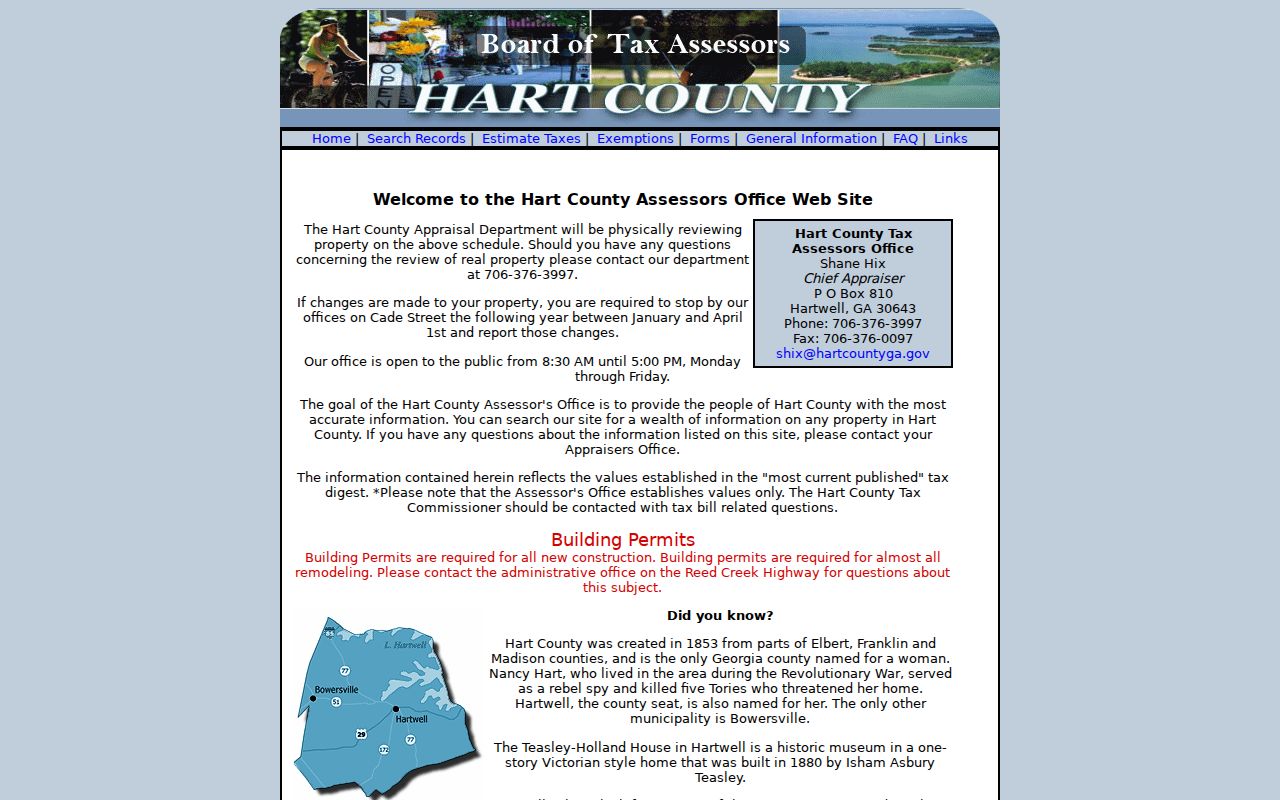
QPUBLIC is the practical door to this parcel inventory. The packet shows what a Hart County parcel card can display. Neither card nor sketch is a survey. Neither one replaces a complete title report.
Carry the Hart Owner Name into GSCCCA
QPUBLIC hands you the exact owner spelling. Carry it to the GSCCCA real-estate name search and limit the query to Hart County. Preserve suffixes, and try sensible variants for an LLC, trust, estate, or married name, since the index may list a person as grantor, grantee, borrower, lender, trustee, or another party. A name hit alone does not establish ownership.
| Known party | Name search with county and date filters |
|---|---|
| Known citation | Book/page search for the instrument |
| Known subdivision | Property search where Hart participation and indexing allow |
| Missing web result | Public courthouse viewing or a direct Clerk request |
The book and page route works better when a parcel card or an earlier deed already supplies the citation. It cuts straight to the recorded instrument. The Clerk's county page also points to Kofile for Hart materials. Ask the office about current coverage and charges there.
Why a Hart Sale Row Can Mislead
The official sample card reports two historical sale rows. One lists zero with reason and qualification codes. Such a row can reflect a non-market transfer, a correction, an estate event, or another coded transaction. Treat it as a prompt for a deed search, not a conclusion about price or title.
Use the newest evidence. If a deed was recorded after the parcel card’s upload date, treat the recorded instrument as the newer conveyance event and ask the assessor about roll timing.
Hart County reevaluates parcels annually. No official source gives a standard lag between recording and a QPUBLIC owner update. When timing matters, capture the card's upload date.
Choose a Hart Address, Owner, or Parcel Search
The best key depends on what you hold. A street address feels intuitive. An owner name can locate several holdings, and a map number cuts ambiguity faster than either. Switching keys usually beats repeating a failed query.
| Search Key | Best For | Where It Works | Watch Out |
|---|---|---|---|
| Address | One known site | QPUBLIC and permit files | Zero-number or rural situs |
| Owner name | Holdings tied to a party | QPUBLIC and GSCCCA | Entities, roles, and identical names |
| Parcel number | Exact cross-reference | Assessor, map, and office request | Spaces and punctuation vary |
Not a title search. A Hart County property search locates official records but does not guarantee clear title, resolve an easement, or establish a surveyed line. A Georgia attorney or title professional handles that legal examination.
Get a Hart Record That Is Not Online
Need a Hart County record that never made it online? Start with the Hart County Clerk of Superior Court. The office welcomes public viewing at the Courthouse Annex, 185 W Franklin Street, or by phone at 706-376-7189. The assessor handles parcel questions by phone or email. Planning and E-911 keep address and permit materials, with summaries linked from 2017 forward.
A written request under the Georgia Open Records Act works best when it names the custodian. Include the property, the approximate dates, and the format you want. Georgia asks custodians to respond within three business days. Production, cost, redaction, or an exemption can still matter. That can mean a written follow-up instead of instant delivery.
The Hart County Library is a quiet fallback. It offers public computers, printing, GALILEO, and the Hartwell Sun on paper and microfilm. That run goes back to 1877. Old newspaper notices often surface a subdivision, tax sale, or estate clue. A parcel search alone will miss such finds.
Use Hart County Search Results Lawfully
Public access to Hart County property records still has limits. Georgia Safe at Home lets eligible participants substitute a designated address. Open-record exemptions also shield certain personal and public-safety details. Never fill in a missing address through guesswork or a commercial profile. If a record looks incomplete, ask the custodian about the discrepancy. Do not try to defeat a protected entry. Official systems still identify the responsible office, the record type, and the date. That is what you need to judge any result.
Put a Hart County property search to legitimate uses. These include purchase diligence, boundary research, estate administration, assessment review, and deed-fraud monitoring. Do not use one to stalk, threaten, or harass anyone. Those limits are firm.
Keep a simple research log as you go. Record the query, the spelling, the county filter, and the result date. Add the parcel number and the document citation too. That discipline keeps a search repeatable after a portal refresh. It also stops a mailing address, a city label, or a similarly named owner of record from being mistaken for evidence about the tract itself.