
Check the Hart County Owner of Record Now
The primary source is the Hart County QPUBLIC parcel card. It draws on the county assessment roll. An official county packet supplies a real Schneider card layout, so the card fields are known even though the live portal's search labels sit behind its interface.
| Owner | The name now carried on the assessment card |
|---|---|
| Mailing address | Where assessment mail goes, which may be off site |
| Physical Address | The situs, sometimes unnumbered or shown with a zero |
| Parcel ID and map | The cross-reference tying the owner to the right land |
| Last 2 Sales | Dates, prices, reason and qualification codes needing context |
| Upload data | Date evidence used to judge how current the card is |
The sample card also lists class, taxing district, acreage, assessed value, and a road map. Its warning says it is not for legal documents. Read the owner line as an assessment-roll statement. It is not proof of occupancy or a title opinion. Start any check at the official Hart QPUBLIC portal.
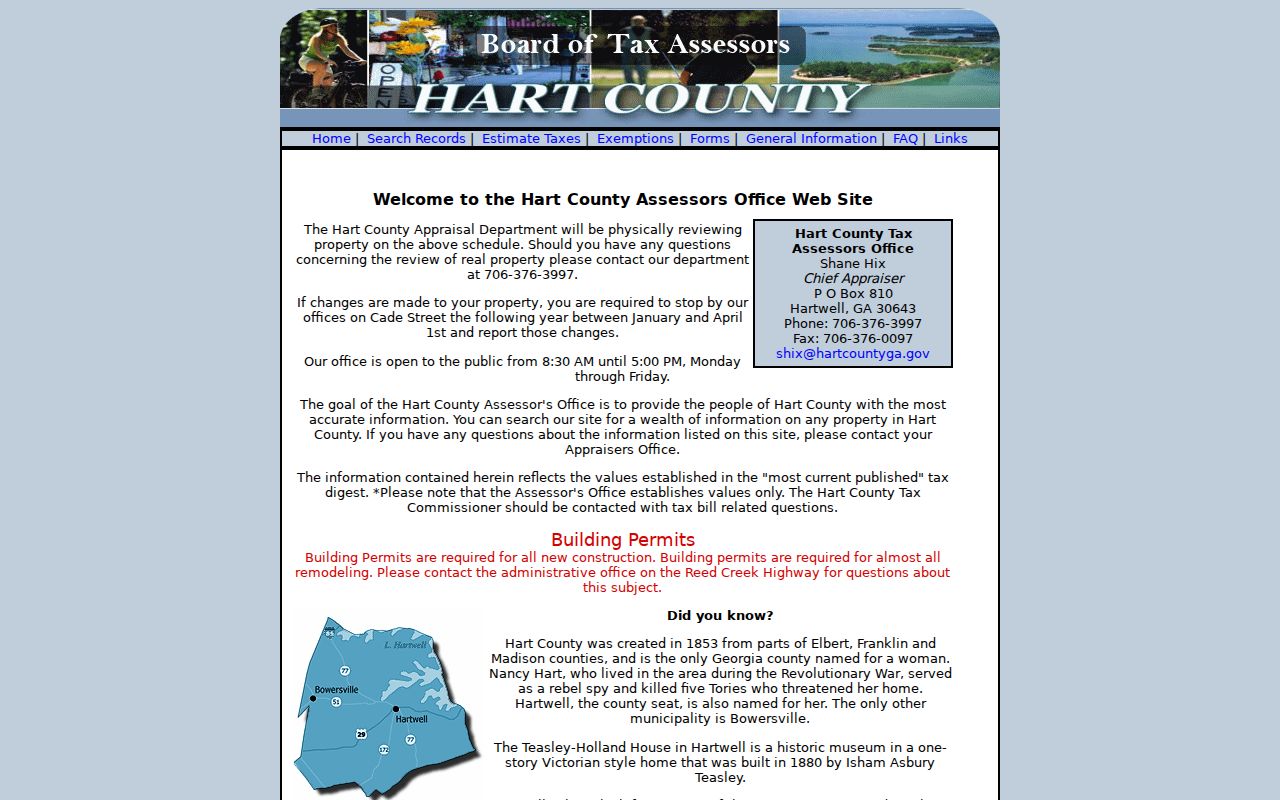
The portal entry leads to the assessment roll. Confirmation still comes from the card date and the latest matching deed.
Measure How Current Hart County Owner Data Is
Every parcel gets reevaluated each year, Hart County says. That is annual review only. It sets no fixed closing-to-roll update window. The official parcel-card sample carries created and upload timestamps. Those dates best reveal the entry's age.
A deed recorded after the card upload is the newer legal event. Call the Board of Tax Assessors at (706) 376-3997 about correction timing. The county publishes no typical lag in days.
Note: An annual parcel review does not mean every owner or assessed value changes each year.
Resolve a Hart County Situs Shown With Zero
The official sample situs reads `HIGHLAND AV 0`. That local shorthand explains why a full street-number query can miss a parcel. Try the road or owner route instead. Then compare Parcel ID, acreage, road map, and neighboring labels. County examples use `157F 010`, `C70B 095`, and `C45-051`. The formats are not interchangeable. The county publishes no parcel-number decoding key, so preserve spaces and punctuation, ask the assessor to confirm a map reference, and let Hart County Building and E-911 address a newer situs assignment.
Confirm the Current Hart County Owner Against the Deed
The Hart County Clerk of Superior Court records deeds. The Clerk's page points users to Kofile and GSCCCA and offers in-person public viewing at the Courthouse Annex.
- Copy the Owner spelling, Parcel ID, situs, and upload date from QPUBLIC.
- Search that party in the GSCCCA name index, narrowed to Hart County and relevant instruments.
- Match the land by legal description or map details, not merely the party name.
- If the recording postdates the card, ask the assessor about refresh timing.
- Owner of record
- The party carried on the assessment roll.
- Situs
- The physical property location, separate from mailing address.
- Recording lag
- The interval between a deed event and a later roll refresh.
Read Hart County Company, Trust, and Estate Owners
Owners can be LLCs, trusts, or estates. Keep the legal suffix intact. The Georgia Secretary of State business route can connect an LLC name to entity details, though a business record does not prove land ownership. Trusts follow the deed's trustee and entity wording. Estates call for the decedent, the administrator or executor, and any representative's deed, always with the same present-focused task: identify the newest instrument tied to the parcel.
Recent transfer: the newest matching deed may be more current than the card, but neither a name match nor portal screen is a title opinion.
Separate Hart County Sale Rows From Current Ownership
The sample parcel card holds two sale rows, one a zero-price event with reason and qualification codes. A zero does not establish a free transfer. Nor does it prove an arm's-length sale. It is a tax-card event, not settled proof. Its underlying deed needs review, and the current owner remains the Owner lead tested against the latest deed; price, assessed value, and ownership are distinct facts.
Reach Hart County Current Owner Sources Offline
The QPUBLIC site shifts its layout. Its controls may differ from one visit to the next. The online parcel search can stall at times. When that happens, the assessor's office answers questions by phone or in person. The Clerk provides public terminals at 185 W Franklin Street, Annex. The office is open from 8:30 a.m. to 5 p.m. and reachable at (706) 376-7189. Copy and certification fees are not posted, so ask about costs before placing an order.
A written request following Georgia Open Records guidance should go to the custodian. That office holds the file you need. Hart County Library also offers computers with access to QPUBLIC and GSCCCA.
Use Hart County Current Owner Information Lawfully
The roll's mailing address is an official contact clue only. It does not promise the owner lives there. Current owner information supports lawful uses like purchase due diligence, deed-fraud response, estate work, and boundary questions. It also serves other property research. Georgia Safe at Home and public-record exemptions can limit address disclosure for eligible people.
Lawful use. Never use Hart County owner information to stalk, harass, threaten, target, or evade protected-address safeguards.
Rank Hart County Current Owner Evidence
When two current-owner sources disagree, rank the evidence. A freshly recorded deed beats an older assessment card. Match the deed correctly first, though. The tax card still earns its place for parcel identity, mailing information, classification, acreage, and the current roll position. A map ties the record to geography but settles nothing about title. Board packets and planning files can explain a parcel split. A proposal, however, is not an approved and recorded instrument.
Keep the exact terms straight while you work. Indexed means the document sits in a finding system. Imaged means a copy can be viewed. Certified means the custodian authenticated it. Assessed describes the tax roll. Recorded describes an instrument accepted into the Clerk's land records. Treat these states as distinct words with distinct meanings, never as synonyms.
When the record affects a purchase, estate, fraud claim, or boundary dispute, save the parcel ID, card date, deed citation, and the office response. The fuller Hart County ownership method lays out the broader route. This current-owner check stops at the newest verified owner event instead.
Check Every Hart County Current Owner Card Detail
A final current-owner review starts with parcel identity. Copy the Parcel ID exactly. Then compare the physical address, road, acreage, class code, taxing district, and map position. The official Hart County sample shows a physical address ending in zero. So a missing street number is no reason to abandon the parcel. Use the map number and road context instead. If the parcel was divided, search the parent identifier alongside the current child number.
Next, separate name fields from contact fields. The Owner line states who the assessment roll presently carries. The mailing address shows where assessment correspondence goes. Neither field proves who occupies the land. For an entity owner, preserve the punctuation and legal suffix. Search that exact wording in the deed index before trying a shortened variant. Compare any Georgia Secretary of State entity result with the deed party. Remember that a registered agent is an entity contact, not automatically the parcel owner.
Finally, save the dates. The parcel card's created or upload date establishes when that view of the roll was current. The deed index supplies recording dates. A deed recorded after the upload deserves immediate review. Party role plus land description must still match. Security deeds, releases, liens, and powers of attorney can name parties without conveying anything. Instrument type separates those papers from the vesting deed.
If certainty matters, ask the Clerk for the image or an authenticated copy. Ask the assessor about its update schedule too. A screenshot works as casual evidence. But the Hart County sample itself warns it is not for legal documents. Keep a citation log with source URL, access date, parcel ID, owner spelling, recording citation, and office contact. That small record makes a current-owner conclusion easier to verify after a roll refresh.