
Read Hart County Property Tax Records
Two constitutional offices divide Hart County property tax records. The Board of Tax Assessors identifies each parcel. It assigns classifications and values, administers exemptions, and hears assessment appeals. The Tax Commissioner then produces the tax bill and collects it. One piece of land can appear on a parcel card. It can also show up on an annual assessment notice, and on a paid-tax record. Each document captures a different stage. Check which stage you hold before drawing conclusions about the appraisal or the tax bill.
| Field | What It Shows | Where |
|---|---|---|
| Fair market value | Assessor's full-value estimate for the stated year | Tax Assessors |
| Assessed value | Georgia assessment basis, generally 40 percent of fair market value | Tax Assessors |
| Exemptions | Relief applied to a qualifying parcel and owner | Tax Assessors |
| Bill and status | Levy, amount due, payment, and delinquency | Tax Commissioner |
| Taxing district | Jurisdiction used in the parcel's calculation | Parcel card and notice |
Georgia generally assesses real property at 40 percent of fair market value under O.C.G.A. §48-5-7. That number is not the last sale price. A sale row on a tax card can show a zero price or a code flagging the reason, so pull the recorded deed before assuming an arm's-length transaction.
Send a Hart Tax Question to the Right Office
The Hart County Tax Assessors publish parcel, value, return, homestead, and appeal guidance. The office answers at 706-376-3997 with weekday hours from 8:30 a.m. to 5 p.m. The Hart County Tax Commissioner sits at 165 W Franklin Street, Room 4. That office takes collection questions at 706-376-3944.
Route your question by its subject. A classification, acreage, mailing address, or appraised value belongs with the assessors. A missing payment, delinquent balance, receipt, or tax-sale issue belongs with the Tax Commissioner. After a recent sale, compare the assessment upload date against the latest deed. Then ask either office to reconcile the owner of record.
Decode Hart's Ad Valorem Notice
A December 2025 Board packet includes a sample 2024 ad valorem notice. It reveals far more than a bottom line. Expect owner and mailing fields, a map number, and fair market value. It also lists assessed and taxable value, exemption details, millage components, a prior-year comparison, and an estimated tax. Keep the tax year in hand. A live parcel screen can run newer than the notice.
| Fair market value | The statutory willing-buyer and willing-seller concept used by the assessors. |
|---|---|
| Assessed value | The percentage-based assessment figure before applicable exemptions. |
| Taxable value | The amount remaining after qualifying adjustments or exemptions. |
| Millage | The levy rate applied per thousand dollars of taxable value. |
| Estimated tax | A year-specific calculation, not a market appraisal or closing statement. |
Georgia DOR's valuation guidance lays out the statewide framework, while Hart's own notice supplies the parcel-specific application.
Look Up a Hart County Tax Bill
Start at Hart QPUBLIC and copy the exact parcel or map number. Then carry that identifier to the Hart County payment site. The payment landing page loads, but its query fields and receipt-history controls vary. Use whatever address or owner search options the site currently presents, and match the result to the parcel number rather than assuming every lookup mode exists.
- Locate the parcel card and copy the map number exactly, including its spaces or punctuation.
- Open the Tax Commissioner's current payment route and match the parcel, owner, and tax year.
- Read the original levy, payment status, and any balance separately from the assessor's value.
- Check the parcel card or notice for exemptions, then contact the proper office when the records disagree.
- Assessed value
- The statutory assessment basis used before exemptions.
- Mill rate
- The rate applied to taxable value to calculate a levy.
- Homestead exemption
- Relief tied to qualifying ownership and legal residence.
- Tax lien
- A claim arising from unpaid tax, which requires current status verification.
Use January 1 for Hart Tax-Year Questions
Georgia DOR values property according to its January 1 status. Hart accepts tax returns from January 1 through April 1. Assessment notices go out by April 15. A sale later in the year does not automatically change every name or obligation shown for that tax year. That date rule explains why a deed, a tax card, and a bill can each be accurate. They simply show different timing.
Hart's assessor page states plainly that every parcel is reevaluated each year. Read that as an annual review, not a promise that every value moves. Georgia DOR lets counties review and adjust values as local conditions warrant. No single statewide revaluation cycle is required.
Note: Capture the record's year and upload date before comparing it with a sale or assessment notice.
Check Hart Millage by the Correct Year
A millage rate is not a fixed parcel trait. County, school, municipal, and other levies shift by year and taxing district. Pull the Georgia DOR millage publications for the year you need. Then match that rate to the district printed on the Hart notice. A Hartwell or Royston mailing address alone proves nothing. City limits and a municipal levy are separate questions.
The point matters most around Royston. Its municipal area crosses into Hart, Franklin, and Madison counties. Confirm the county and municipal geography before comparing tax bills. ZIP codes route mail; they do not set tax boundaries.
Verify Hart Delinquency and Tax-Sale Status
The official Hart tax-sales page identifies the Tax Commissioner's tax-sale route. It publishes no current parcel inventory, though. Treat each stage as distinct. A delinquent balance is one stage, a legal notice another, an advertised sale another, and a completed sale and recorded tax deed are further stages. Confirm the current stage with the office directly. When legal ownership is at stake, check the recorded instrument in the deed records.
Note: The county tax-sales page itself names the office contact point for sale inquiries.
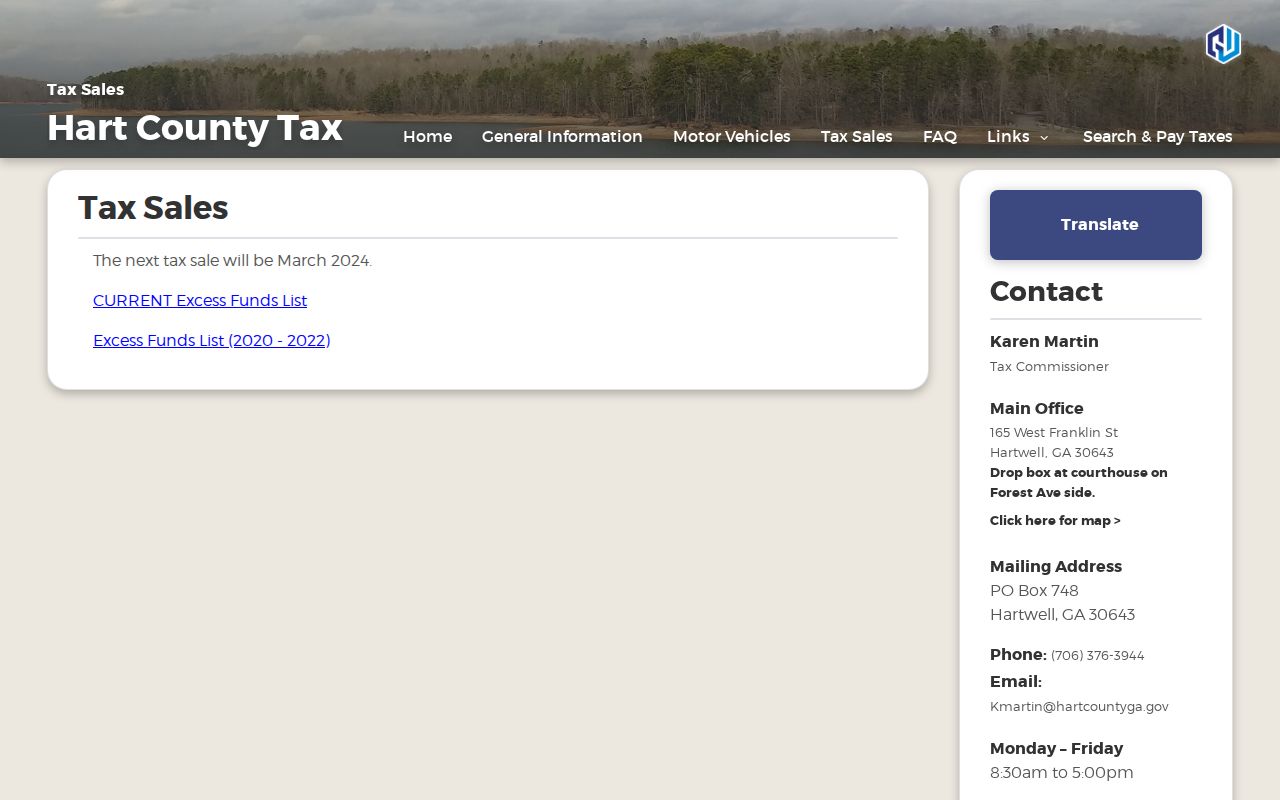
An official page is a contact point, not proof that any parcel is scheduled. The Hartwell Sun's legal notices can add a time-stamped clue. The deed index settles whether a tax deed was recorded.
Appeal a Hart County Assessment
When the assessors change a returned value, Hart requires an appeal postmark within 45 days. The clock runs from the change assessment notice. File first with the Board of Tax Assessors. Keep the envelope, the notice, the parcel card, photographs, comparable sales, and any survey or factual correction that supports the claim. From there, Georgia offers routes through the Board of Equalization, arbitration, or superior court. The route depends on the election and the issue.
Appeal window. Use the deadline printed on the notice. Hart publishes a 45-day postmark rule for a changed assessment, not one floating calendar date for every parcel.
Confirm Hart Homestead and Special Relief
Homestead relief in Hart County has two basic requirements. You must own and legally reside on the property on January 1, and file by the applicable deadline. The details stay local. Hart County's exemption chart sets out its own categories and dollar figures, so read the current county version instead of a generic Georgia list. Ask the assessors which proof fits the parcel.
The Georgia DOR 2026 Property Tax Relief Grant page describes a law signed May 12, 2026 and a qualifying-homestead cut in assessed value. That is statewide guidance. It does not confirm a specific Hart County tax bill result, so verify county participation, qualification, and the calculation before estimating savings.
Separate Hart Real Estate from Other Tax Accounts
Hart County's Tax Commissioner also handles mobile-home, timber, and intangible tax accounts, while the assessor posts separate return and program guidance for them. Keep them out of a real-property parcel search. A mobile home brings decal, land, and structure records. Those identifiers differ from a parcel number, and timber activity can create a tax record without any ordinary home sale.
When the portal fails, you still have options. Call, visit the counter, or write the office. Under the Georgia Open Records Act, identify the parcel, year, record type, and preferred format. Georgia's ordinary response target is three business days. Production, costs, redaction, or an exemption can delay access, and the office gives notice when it does.