
Understand Hart County Deed Records
The Clerk of Superior Court keeps Hart County deed records. Deeds, security deeds, liens, releases, and plats each answer a different question. A tax card, by contrast, mainly locates the parcel. Identify the instrument type first. The filing category tells you which question the record can actually answer.
| Deed Type | What It Does | Common Use |
|---|---|---|
| Warranty deed | Conveys the stated interest with warranties | Ordinary purchase and sale |
| Quitclaim deed | Conveys whatever interest the grantor holds | Family transfer or title cleanup |
| Security deed | Secures a Georgia real-estate debt | Financing rather than a simple sale |
| Executor deed | Conveyance made through estate authority | Estate sale |
| Tax deed | Instrument following a tax-sale process | Delinquent-tax property |
A recorded deed can list the parties, execution and recording dates, consideration, legal description, book and page, and any plats it references. Read the image.
Use the Hart Clerk's Records Routes
The Hart County Clerk page organizes access into public viewing, Kofile, GSCCCA, and ICON court records. Land instruments live in GSCCCA or at the public counter. ICON serves case files and requires setup. The office sits at 185 W Franklin Street in Hartwell, keeps 8:30 a.m. to 5 p.m. hours, and answers at 706-376-7189. Kofile's Hart coverage, search fields, and image charges should be confirmed before relying on it. In-person viewing remains the dependable fallback.
Search Hart Deeds through GSCCCA
The GSCCCA real-estate index supports several routes.
| Path | Known input | Use |
|---|---|---|
| Name | Party, county, dates | Find instruments connected to a person or entity |
| Book/page | Book type, book, page | Retrieve a known citation |
| Property | Subdivision, unit, block, lot | Find indexed plat-related instruments where available |
| Lien | Party, instrument, dates | Locate a lien and any release |
GSCCCA reports coverage back to at least 1999. That figure is not Hart's exact good-from date, so confirm the county's specific range in the live system or with the Clerk.
Trace Hart's Grantor-Grantee Chain
The grantor conveys; the grantee receives. Start from the newest matching deed, then use that deed's grantor to locate the earlier acquisition that gave them title.
- Copy the exact current roll owner and parcel ID from Hart QPUBLIC.
- Search that owner as grantee in Hart County.
- Read the deed's grantor, legal description, book/page, and referenced plat.
- Search the grantor's earlier acquisition; repeat and check name variants.
- Grantor
- The conveying party.
- Grantee
- The receiving party.
- Chain of title
- The linked sequence of conveyances for one tract.
- Book/page
- The clerk's recorded citation, sometimes paired with an instrument number.
Royston sits in three counties. Establish whether the property lies in Hart, Franklin, or Madison first, because the recording county and the legal description control where the deed lives.
Match Hart Deeds to Recorded Plats
A map number is only a cross-reference, not the deed's legal description. Recorded plats can show lot lines, rights-of-way, easements, restrictions, and parent parcels. Rural tracts often run on metes and bounds instead. Hart planning guidance notes that a subdivision may appear in a deed, on a plat, or as the remainder of an earlier division. The 2025 Hartwell Acres planning packet names original parcel C45-051, but a packet is planning evidence. A later recorded deed or plat supplies the proof.
Watch Hart Filings with FANS
GSCCCA FANS lets an owner or authorized user register name variants. They then get notice of matching filings. That makes it a useful deed-fraud alert. It cannot block a filing, though, and a match is not proof of fraud. Investigate each alert through the Clerk and the actual instrument image.
Obtain a Hart County Deed Copy
A citation makes things easy. Use the GSCCCA book/page search when a citation is known. You can also inspect the record at the Clerk's office. GSCCCA publishes its current account and image terms. The Hart page posts no local copy or certification fee schedule. So confirm cost and delivery before ordering. The official GSCCCA name-search form finds indexed parties by name.
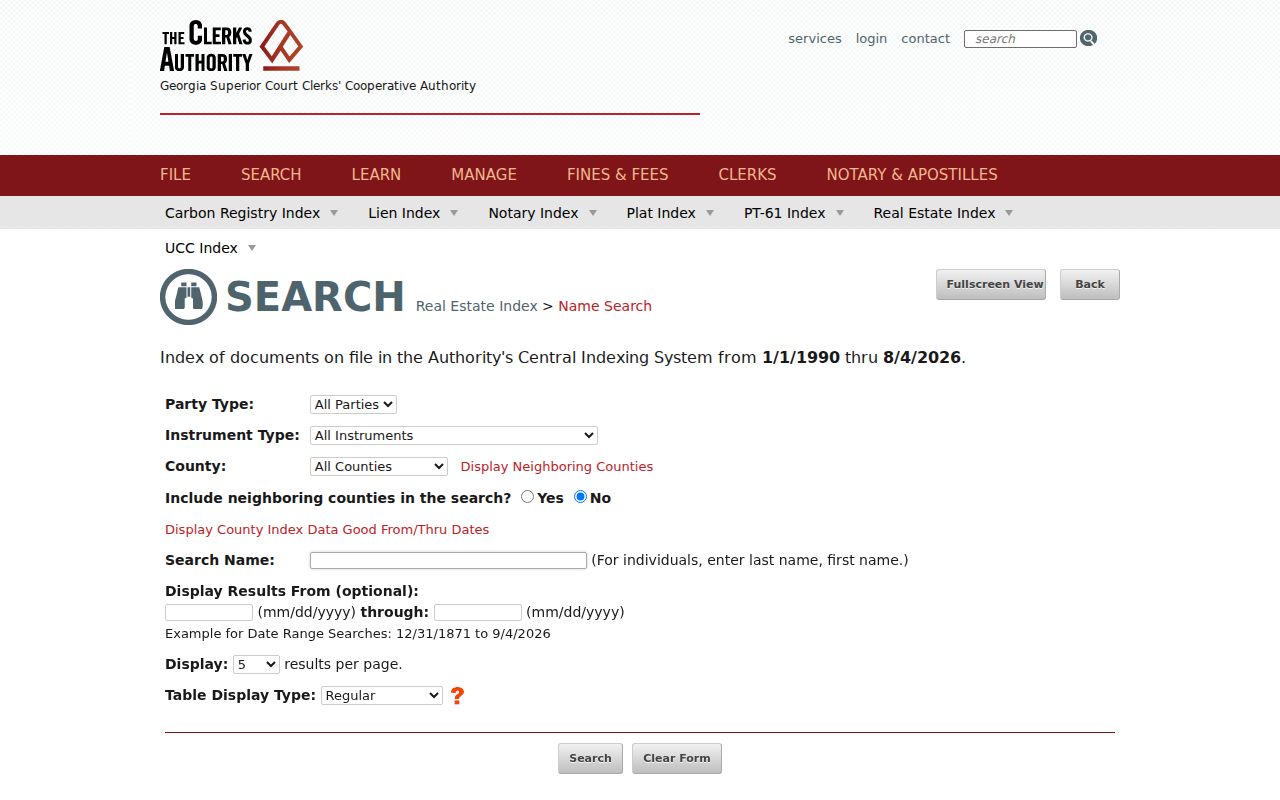
An index row locates parties. The deed image, and a clerk-certified copy when needed, carries far stronger evidence than the result line ever can.
Recorded, not guaranteed title. Recording establishes a filing event; it does not certify clear title or eliminate possible unrecorded interests.
Follow Hart Records before Online Indexing
Hart County was formed in 1853. It was carved from Elbert and Franklin counties. A tract predating that split may sit in parent-county records. The Georgia Archives county microfilm collection films deed books, tax digests, and probate materials. Its county-card index shows which volumes were filmed. Old reels are browsed, not searched. Expect to move by book, page, and image rather than by owner name. Hart County Library offers public computers. It also keeps the Hartwell Sun in paper and microfilm from 1877, a source for estate, sale, and subdivision notices.
Separate Hart Index Parties from Owners
A GSCCCA result can name a grantor, grantee, borrower, lender, trustee, attorney-in-fact, beneficiary, or lien claimant. "Party" does not mean owner of record. Open the instrument and identify the role. Match the legal description before adding any name to the deed chain. A security deed secures debt under Georgia practice rather than conveying a sale, and its original recording says nothing about the present loan balance.
Entity and estate names demand deliberate variants. Search an LLC by full legal name. Add suffix forms too. For a trust, try the trust wording and the trustee; for an estate, run the decedent, the estate, the executor or administrator, and any fiduciary deed. A married-name change or an indexing quirk can break a name-only chain even when the legal description runs on unchanged.
Treat liens and cancellations separately. A lien is only a lead. Read the instrument, the party's role, the property reference, and any later release together. UCC filings concern secured transactions and enter real-estate title only when the collateral language actually touches the land.
Request an Unindexed Hart Instrument
The name, property, and book-and-page searches may all come up empty. The Clerk's counter is the next stop. Bring the parcel ID, any legal-description fragment, party name variants, and an approximate date. Bring the suspected document type too. Courthouse terminals and bound volumes can reveal a book index or local context. A statewide website simply does not carry it. Say whether you need a plain image or a certified copy. Ask staff to confirm current copy and certification charges before they print anything.
A focused request under the Georgia Open Records Act should identify records. It should not ask the Clerk to run a title examination. Georgia's ordinary response target is three business days. If retrieval, cost, redaction, or an exemption delays production, the office must send written notice. Keep the response with your chain notes. That way a later researcher can see what was searched and what stayed unavailable.
The Clerk's own page states that most real-estate records are public and open for viewing at the office. That channel matters when Kilogue-level access fails. It matters when a deed image demands an account, or a handwritten reference must be traced into a bound book. It also helps when a subdivision term was never indexed. Bring the parcel card and every citation you hold. That lets staff separate similarly named parties, old descriptions, and adjoining tracts without guessing which instrument you mean. Write down each failed query's spelling and date.